

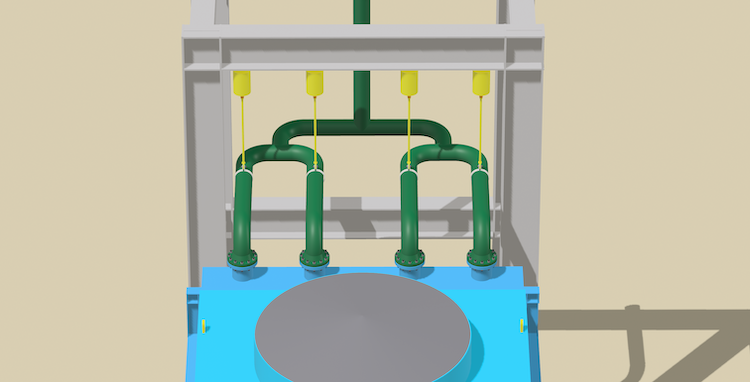
Modeling an Air Cooler in Caesar II
Required Information for Air Cooler Modeling
Before performing a piping stress analysis involving an air cooler, the piping stress engineer must obtain the relevant technical information by reviewing the manufacturer's data sheets, general arrangement drawings, or consulting the equipment manufacturer directly.

Analogical / Acoustic Study
Reciprocating compressor piping systems are highly sensitive to pulsation and vibration effects caused by dynamic pressure fluctuations. If these effects are not properly considered during the design stage, they may lead to excessive vibration, fatigue damage at branch connections, and even premature failure of piping components. For this reason, an analogical (acoustic and pulsation) study plays a critical role in evaluating the dynamic behavior of compressor piping systems.

Calculating Seismic g-value for Caesar II Using ASCE 7
In Caesar II, seismic loads can be defined using g-values, which represent the acceleration due to gravity as a fraction or multiple of the gravitational acceleration (9.81 m/s² or 32.2 ft/s²). The g-value is a critical input for seismic analysis, as it determines the magnitude of the seismic forces applied to the piping system. Here's how you can determine the appropriate g-value for your analysis:

WIND EFFECT ON PIPING SYSTEMS
Wind loads are critical in designing industrial piping systems, especially in regions where wind intensity can reach high levels. These loads can significantly affect the overall structural integrity of a piping network. This article will discuss the impact of wind on piping stress, the necessary load cases for wind analysis in Caesar II, detailed calculation methods, and relevant international codes.


Horizontal Vessel Piping Stress
Learn how to analyse a piping line connected to a Horizontal Vessel by using Caesar II Software.

Alternate Sustained Case
The "Alternative Sustained Case" in CAESAR II is a specialized load case used in piping stress analysis to evaluate the effects of sustained loads under specific conditions that differ from the standard sustained load case. This case is particularly useful when the piping system has unique configurations or operating scenarios that require a different approach to assessing sustained stresses.

Expansion Loop Calculation - CAESAR II
Sometimes, fluids need to be transferred from the far side of the plant. We can’t leave the long-run piping without restraints, especially since the lines contain high-temperature fluids in the low ambient temperature environment.
The restraints on the long-run strait piping are crucial. However, due to thermal expansion and seismic events, the stoppers take excessive loads, making it impossible or expensive to design a special support.
By the expansion loops, we can reduce the stopper’s load by sharing. This will allow us to control the line better.